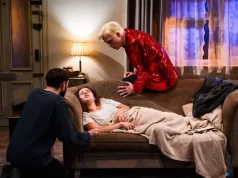






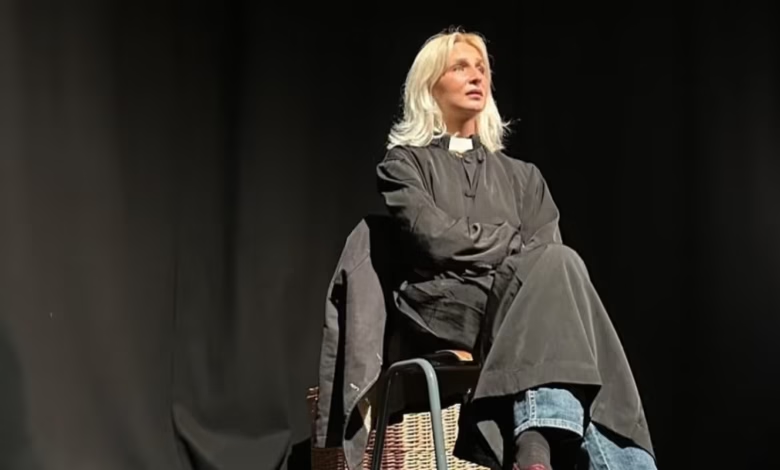


















Breakthrough one-woman comedy Sit or Kneel opens at The Other Palace Studio, Victoria, from 21–26 October (press night: Wednesday 22 October). This sharply observed, darkly funny coming-of-age story follows Margot, a young vicar in her twenties who finds herself accidentally ordained and leading a parish she doesn’t quite understand, while quietly unravelling behind the scenes. Set in a village of unsolicited advice and passive-aggressive casserole drops, it’s a witty, warm, and emotionally biting ode to rural British life.
The play is the debut of writer and performer Mimi Nation-Dixon, who trained with the National Youth Theatre and earned a First in Theology from Durham University. Inspired by her dissertation on how female vicars are represented in comedy, Mimi has shaped Sit or Kneel into a timely exploration of gender, grief, ambition, and identity—after a sold-out, critically acclaimed run at the Fringe.
We sat down with Mimi to hear more about the show, her influences, and why audiences won’t have met a Margot before.
Sit or Kneel has been described as “the perfect amalgamation of Fleabag and The Vicar of Dibley.” How do you feel about those comparisons, and what makes Margot’s story stand apart from those iconic characters?
Like most writers, my first instinct was to bristle at comparisons. You cling to the idea that your voice is unique, your character is unique, your work is unique. Correction: I think that’s true of everyone. No individual believes that somebody else truly sees the world like them. We are all so insistent on our own uniqueness. We aren’t wrong. That’s why the word sonder exists.
So initially, I resisted the comparisons. Then I realised how flattering they are. And, if I’m honest, how much sense they make. Margot is a young woman stumbling through a world she hasn’t yet mastered (Fleabag), and she also happens to be a vicar (The Vicar of Dibley).
What makes Margot distinct is the collision of identities she holds within herself. Each one feels real to her, but together, they can’t all survive. And then there’s the setting: a young woman in a community largely made up of older people. It sharpens the coming-of-age tension and makes her struggle feel more vivid.
“Audiences won’t have met a Margot before. But I hope they’ll recognise themselves in her.”
You studied Theology at Durham and even wrote your dissertation on how female vicars are represented in comedy. How did that academic background shape the creation of Sit or Kneel?
For comedy to resonate, it has to feel real. Theology gave me the grounding to create that reality.
I’ve always been a bit of a secret swot, so the research side of Sit or Kneel was a joy. Watching the play, you won’t find me dissecting ancient Hebrew mid-scene, but having a deeper understanding of the church, its role in communities, and how religion has been interpreted across time and culture, all fed into creating something authentic.
And yes—my dissertation title was How Richard Curtis Said Yes to Vicars in Knickers. While my peers were drowning in journal articles, I was watching The Vicar of Dibley. I quite literally had the last laugh.
That research helped me make Margot layered, dimensional, and funny.
Apologies to my university lecturers—but the daydream potential from my degree was rife. In lectures, we’d study a “passage of the week,” and I’d find myself working out how to spin it into a scene.
Daydreaming up there with one of my favourite hobbies. Most of those never made the cut—but they did make 9am lectures slightly more bearable.
The play tackles themes of identity, grief, ambition, and gender, all while being very funny. How do you strike the balance between sharp comedy and emotional depth?
For something to be funny, it has to be real. And once you write with truth, those themes inevitably seep in, because they’re part of being human.
I love the way comedy can soften an audience. Laughter thaws us just enough to let more serious ideas land. Charlie Chaplin put it best: “Life is a tragedy in close-up, and a comedy in long shot.” I think that’s the sweet spot—finding the humour that doesn’t erase pain, but reframes it so we can look at it together.
“Comedy doesn’t erase pain—it reframes it so we can look at it together.”
I don’t aim for a neat balance—that would feel contrived. The comedy and the emotional depth weave together naturally. At the end of the day, it’s just about following the truth of the character, and letting the humour and heartbreak live side by side.
After a critically acclaimed, sold-out Fringe run, Sit or Kneel is now coming to The Other Palace. What has changed or evolved in this new version of the show?
The essence is the same, but the world around Margot has deepened. Writing the TV pilot forced me to flesh out the parish beyond her, and that understanding filtered back into the play.
Edinburgh was a live experiment. I’d tweak things daily, depending on what landed with audiences. That freedom—the lack of fear about “failing”—created so much spontaneity.
In this new version, there’s a character who’s far more present, and the audience are drawn deeper into Margot’s world. It feels more grown-up. The first version was written from my university room. This one was written largely in Café Nero. A maturity of setting, a maturity of play. One would hope.
(Though I was tempted to pretend it was written in some artisanal coffee house where the beans had been aged in eco-caves and washed in distilled water from the Red Sea. But alas, it was Nero. And, for the record, one of the regulars there did end up inspiring a character.)
The show coincides with the 33rd anniversary of women being allowed to become priests in the Church of England, yet women are still underrepresented in clergy roles. What conversations do you hope the play sparks?
Thirty-three years on, and fewer than 33% of clergy leadership roles are held by women. It remains one of the most gender-imbalanced professions. Margot is never just “a vicar”—she’s a “female vicar.”
When I chose to make her a priest, it wasn’t with the aim of making a political statement. I just thought it was a fascinating job: one that comes with a literal mask for the outside world, which felt like a heightened version of the masks we all wear.
That’s where the power lies. The fact she’s female is the least interesting thing about her—what’s interesting is that she’s human. Normalising that is, in its own way, political.
But of course, questions about gender, authority, and representation inevitably surface. Who gets to embody authority in an institution steeped in male tradition? How do sitcoms shape our idea of what women can be, from The Vicar of Dibley to Fleabag? Comedy has the power to shift perceptions.
“The fact she’s female is the least interesting thing about her—what’s interesting is that she’s human.”
And it’s worth remembering that, even in television, less than 35% of scripted comedy in the last few years has been written by women. Representation is still an uphill climb.
You’ve also developed Sit or Kneel into a TV pilot. What excites you about translating this one-woman play into a series?
The joy of the series is the world. From the beginning, I imagined Sit or Kneel as an ensemble piece. The play was my way of testing Margot, but the screen allows the whole parish to breathe.
On stage, the focus is her interior life. On screen, we see her bounce off the eccentricities, frustrations, and warmth of the people around her. Village life becomes bigger, funnier, more urgent. The church itself is at risk, which raises the stakes.
I’ve grown so fond of the wider cast of characters. They’ve been living in my head for years, and bringing them fully to life has been a joy. Expect a deeper, sharper, funnier version of Margot’s story—and the messy, lovable world she belongs to.
Listings
Sit or Kneel
📍 The Other Palace Studio, 12 Palace St, London SW1E 5JA
📅 21–26 October 2025 (Press Night: 22 October)
⏱ Running time: 1 hour
🎟 Tickets from £19.50 | Book here
👤 Age guidance: 14+