

























Does the constant, relentless tether to your smartphone leave you feeling utterly exhausted? Between the cycle of doom-scrolling, news alerts, and the professional necessity of being plugged into the web for your day job, the digital world can feel inescapable.
If you have ever found yourself craving a genuine break, you aren’t alone. In his book, Leave Your Phone at the Door: The Joy of OFFLINE, Howard Lewis proposes a refreshing alternative. Rather than a total rejection of technology, he offers a practical, grounded guide on how to carve out space to go offline, recalibrate, and—most importantly—re-embrace the vibrant world happening right in front of you.
We sat down with Howard Lewis to discuss his philosophy, the challenges of breaking free from the “digital default,” and how we can begin to reconnect with the world around us.
Q: What do you want readers to take away from Leave Your Phone at the Door regarding the shift from a “digital default” to a more mindful existence?
Howard Lewis: The key element is recognising that it is available to everyone. There are no barriers, no special qualifications and there is certainly no age limit. Indeed, if I can do it, so can you! Your digital existence will not be diminished as a consequence and it will likely be enhanced.
And, of course, mindfulness is not neatly packaged. It comes in all shapes and sizes. But I do want readers to prioritise mindfulness before automatically reaching out to a device as an essential crutch with which to navigate their day. It revolves around learning about yourself and having the confidence to recalibrate aspects of your life in a modest way.
Nobody needs to move mountains. Just a regular stroll in the park or a day without music would be a decent start. There are so many stimuli around us already to kickstart the process. And silence is one of them.
Q: You’ve noted that “people are far more concerned with what may go wrong than what may go right.” How do you think this fear acts as a barrier to the “offline” lifestyle, and how can we shift that mindset towards curiosity?
Howard Lewis: This sense of fear causes inertia whereby people become paralysed by the prospect of stepping out of their comfort zone. But this behaviour is dominated by a kind of groupthink in which they are excessively concerned about falling outside the perceived view of their circle, as if they were acting like a renegade.
There is nothing very complicated about the OFFLINE ethos but it does require you to take an occasional chance. Curiosity should be considered as an accompaniment to the certainties of life not an obstacle.
If you simply ask others what they are passionate about, the conversation may lead in fascinating directions. When you give others the floor, you demonstrate kindness and respect. You may not be expert yourself in the subject but that does not matter. You are present and that is what really counts.
Q: You write that “our constant reliance today upon personal technology is stripping our sensibilities bare.” Which specific “sensibilities” do you feel we are losing most urgently?
Howard Lewis: Listening conscientiously and paying attention. Bidding good morning to people you pass on the street. Smiling, waving, hello, please and thank you all tend to be vote winners. These are not challenging manoeuvres. You don’t have to go to college to study them.
They are instinctively within us but frequently suppressed due to a fear your actions might be misinterpreted or draw undue attention to yourself. But if you spend your time looking down at your screen, you are not looking up at the world. And the world is assuredly a far more interesting place!
The obsession with self improvement and excellence in every endeavour reflects the jarring competitiveness of society but it is our foibles and idiosyncrasies that best define us and they should be celebrated accordingly.
Q: Given that the OFFLINE project has been running for over fifteen years, how has your view on the “alarming behavioural trends” of social media changed from when you first started to today?
Howard Lewis: The premise behind social media was fundamentally sound, as a means to connect disparate individuals or groups. But there is a lawlessness to it today, both untrammelled and unchecked, that makes a mockery of the intentionality of the original idea.
The inexorable rise in online manipulation, hacking, conspiracy agendas, fake news, stalking, identity theft and the rest mark an extreme distortion. Social media has also become a breeding ground for those with the most malign motives, often accessed via the dark web, and the debate around the ban on usage by children is thus timely and relevant.
There will always be bad actors, whom you cannot straightforwardly restrain, but there should be far more emphasis upon rewarding best practice and content through social media platforms.
Q: As AI makes our daily paths even more automated, how do we intentionally “veer off-road”—as you suggest—to keep our lives from becoming entirely defined by convenience and familiarity?
Howard Lewis: Use your hands. Any activity where your mobile is a clear impediment should be welcomed and endorsed. Swimming, knitting, planting vegetables, cycling and tree climbing are all good examples!
Yet I am also a great believer that travel expands your mind and perspective. You need not go far. Simply visiting another town may open your eyes in revealing ways. When you are on unfamiliar ground, you tend to be more observant. Inconvenience can sometimes be your friend, since It encourages spontaneity and improvisation and acts as a reminder of what makes us human.
If you embrace an element of risk rather than instantly shun it, you may be surprised on the upside. Moreover, AI is a choice. Stop following the herd and choose for yourself. AI won’t miss you. It won’t send you a birthday card or pop over for a cup of tea.
Q: You’ve built your OFFLINE dinners as the “antithesis of everything online.” What are the specific “codes of conduct” you’ve observed there that you think would most improve our everyday, real-world interactions?
Howard Lewis: I always adopted an egalitarian approach. Whether you were pope, president or plumber made no odds to me. And when those barriers are broken down, all bets are off.
At every dinner I hosted, I told the assembled at the outset that I was reliably useless at most things myself but so what? We all have our own strengths and weaknesses but nobody was keeping score! The crux was that I gave them permission to be vulnerable and invited them all to display an open mind and a generosity of spirit.
That was the only code of conduct I really cared about. And they responded in kind. A little intrigue and devilry kept them on their toes, plus the excellent company surrounding them, and reaffirmed my view that, wherever you go in the world, you will find there is far more that connects rather than separates us.
Your Invitation to Unplug
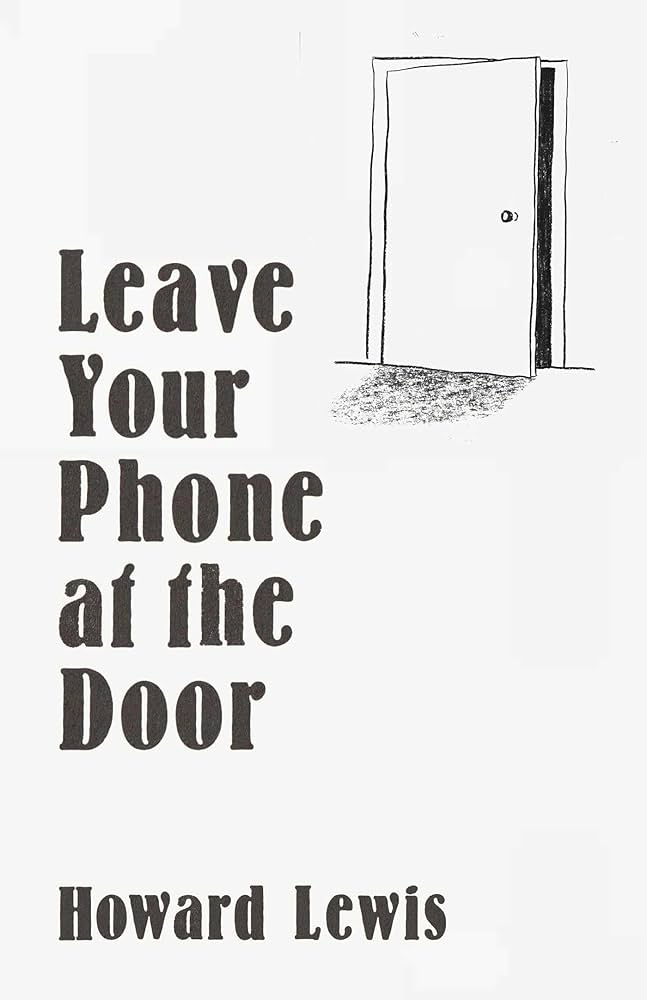
Leave Your Phone at the Door is a must-read for anyone feeling buried under the weight of constant connectivity. Howard Lewis writes with a warm, conversational style, filling the pages with delightful anecdotes—such as his serendipitous encounters on his travels—that make the philosophy of living “offline” feel both accessible and deeply human. Rather than being a dry manifesto, the book serves as a practical, encouraging toolkit for anyone looking to reclaim their time and attention.
You can find the book available in various formats to suit your lifestyle:
Support Local: Check your favorite independent bookstore’s website—many can order it for you if it isn’t currently on the shelf.
Retail Giants: Order your copy through Amazon, Barnes & Noble, or Blackwell’s.
Publisher Direct: Check out the latest editions and author insights via Simon & Schuster.
Digital & Audio: For those who prefer to read or listen on the move, it is available on eBooks.com, Audible, and Apple Books.